
-
E-mail:
hbjn1875@gmail.com -
Tel:
8617363170189
E-mail:
hbjn1875@gmail.comTel:
8617363170189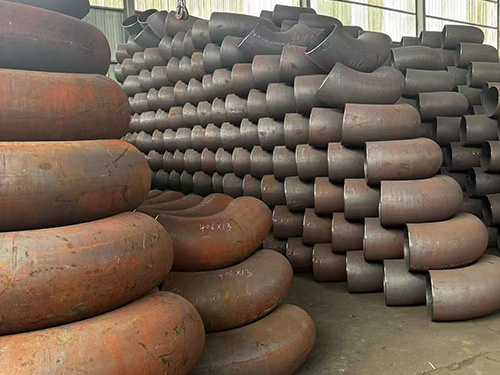
Carbon steel elbow is the most common curved pipe fitting used to adjust fluid flow direction in industrial piping networks. It covers 45°, 90°, and 180° types, available in long radius and short radius versions, with seamless and welded manufacturing options for butt-weld connection. Featuring excellent mechanical performance and prominent cost advantages, carbon steel elbow occupies the largest market share in general industrial, power and municipal fluid transportation projects.
Carbon steel elbows are produced in compliance with international standards including ASME B36.10, ASME B36.19 and GB/T 12459. A234 WPB is the mainstream material grade for carbon steel elbows, suitable for medium under normal and moderate high temperature conditions. For higher temperature and pressure working conditions, special carbon steel grades can be customized. Seamless forming is adopted for small and medium diameter specifications, while large-diameter carbon steel elbows are generally manufactured through steel plate rolling and welding processes. The complete specification range can meet diverse layout demands from small auxiliary pipelines to large trunk transmission pipelines.
Hot pushing and cold bending are the primary molding technologies for seamless carbon steel elbows. Whole steel pipe blanks are heated and extruded by professional molds to form uniform smooth bending arcs. Rolled welded carbon steel elbows are fabricated by rolling steel plates into arc segments followed by welding. After forming, normalizing and tempering heat treatment is conducted to eliminate residual stress generated during plastic deformation, stabilize metal structure and improve impact resistance. Both ends are precisely machined with standard welding bevels to achieve full penetration butt welding with matching carbon steel straight pipes. All finished carbon steel elbows go through strict quality inspection procedures, including dimensional tolerance detection, wall thickness measurement, surface visual inspection and ultrasonic non-destructive testing, to prevent defects such as wall thinning, wrinkles and microcracks on bent sections.
The biggest advantage of carbon steel elbow lies in balanced strength and economic efficiency. Carbon steel possesses good tensile strength, plasticity and weldability, which facilitates convenient on-site welding and assembly. Raw material resources are abundant, and processing technology is mature, effectively lowering overall engineering procurement costs. Long radius carbon steel elbows create gentle flow turning paths, reduce fluid pressure loss and medium erosion, making them the preferred choice for most process pipelines. Short radius carbon steel elbows feature compact dimensions and are adopted when installation space is tight.
Engineers need to fully understand its limitations during type selection. Carbon steel lacks natural anti-rust capability. When exposed to humid air or corrosive fluid, rust will gradually form on the inner and outer surfaces. Therefore, anti-corrosion treatments such as painting, anti-rust coating or galvanizing are required according to service environments. Carbon steel elbows are not suitable for long-term transportation of chloride-containing, acid and alkaline corrosive media; stainless steel fittings shall be selected for such working conditions. In addition, appropriate pipeline supports should be arranged nearby to bear fluid impact and avoid excessive stress concentration on welding joints.
Carbon steel elbows are widely deployed across a wide range of industries. Typical application scenarios include thermal power plant auxiliary pipelines, petrochemical common process pipelines, urban heating networks, municipal water supply and drainage systems, natural gas transmission pipelines, and factory compressed air, fuel oil circulation systems. Carbon steel elbows are the standard matching fitting for nearly all non-corrosive medium transportation projects.
In piping system design, carbon steel elbow is the preferred option for projects without strict anti-corrosion requirements. Designers select long radius or short radius specifications reasonably based on pipeline layout space, flow rate and medium characteristics. Although additional anti-corrosion investment is needed, its low purchase price brings obvious comprehensive economic benefits for large-scale projects.
With complete specification series and stable mass-production technology, qualified carbon steel elbows provide reliable flow steering solutions. As the most widely used pipe fitting category, carbon steel elbow ensures continuous, stable and cost-effective operation of fluid transportation infrastructure in global industries.