
-
E-mail:
hbjn1875@gmail.com -
Tel:
8617363170189
E-mail:
hbjn1875@gmail.comTel:
8617363170189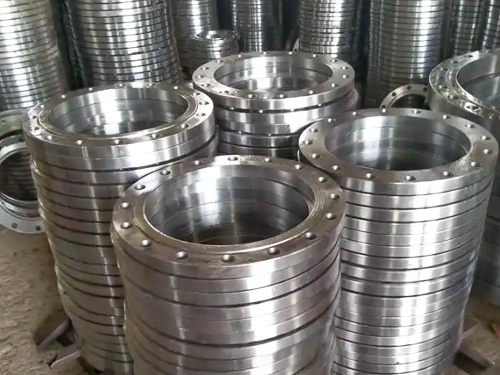
Plate flange, also known as plate slip-on flange or flat flange, is a basic low and medium-pressure connecting component widely applied in general industrial and municipal piping systems. It is manufactured from flat steel plates without forged hub structure. Pipes penetrate the central bore of the plate flange and are fixed by fillet welding on both sides. Benefiting from simple processing technology and favorable cost performance, plate flanges are extensively adopted in non-critical pipelines and equipment connections, becoming one of the most economical flange choices for conventional fluid transportation projects.
Plate flanges are produced according to prevailing standards including ASME B16.5 and GB/T 9119. Multiple material grades are available to satisfy different service environments. Carbon steel plate flanges are normally made of Q235B or A105, featuring outstanding economic benefits, suitable for pipelines conveying water, heating steam, compressed air and fuel oil. Stainless steel plate flanges in 304 and 316L grades possess excellent rust and corrosion resistance, widely used in purified water, food processing and wastewater treatment pipelines with medium anti-corrosion demands. Custom alloy steel plate flanges can be supplied for special moderate temperature working conditions based on client technical specifications. Common pressure classes range from Class 150 to Class 300, and the raised face (RF) is the standard sealing surface for most applications.
The core production technology of plate flanges is plate cutting and machining. Raw steel plates are cut into circular blanks by plasma cutting or laser cutting. Subsequent processing steps include boring the central hole, turning the sealing surface and drilling bolt holes. Unlike forged flanges, plate flanges omit complex hot forging procedures. For thick-specification plate flanges, stress relief annealing treatment can be arranged to reduce internal processing stress. Every finished plate flange undergoes strict quality inspection, covering dimension tolerance measurement, flatness testing, visual surface inspection and sampling mechanical property tests to avoid defects such as uneven thickness and surface deformation.
The most prominent advantage of plate flange is low comprehensive cost. Raw material utilization rate is high, and the processing flow is simplified without hot forging, greatly shortening production cycles and lowering manufacturing expenses. Installation operation is user-friendly: workers only slide the flange onto the pipe end and complete double-sided fillet welding without pre-processing pipe welding bevels. Such characteristics reduce technical requirements for construction teams and speed up field assembly progress.
However, the structural shortcomings restrict its applicable scope. Without reinforced hub transition, plate flanges have weaker overall rigidity compared with slip-on forged flanges and weld neck flanges. Stress tends to concentrate at welding joints under pressure impact, pipeline vibration and temperature alternation. The fillet welded connection cannot achieve full penetration, bringing potential leakage risks. Therefore, plate flanges are prohibited for high-pressure, high-temperature pipelines and pipelines transporting flammable, explosive or toxic media. They are also not recommended for long-distance main pipelines with continuous severe vibration.
Plate flanges cover massive general engineering scenarios. They are widely used in municipal water supply and drainage networks, building fire protection piping, factory cooling water circulation, low-pressure heating systems and light industrial equipment auxiliary pipelines. Stainless steel plate flanges are favored for environmental protection water treatment and beverage production lines. Carbon steel plate flanges dominate infrastructure projects and low-pressure auxiliary piping systems.
During engineering selection, designers must distinguish plate flanges from hub-type slip-on flanges. Plate flanges are preferred only for stable low-to-medium pressure working conditions without drastic load changes. For critical process pipelines, forged flanges with hubs should be selected to guarantee long-term operational safety.
With simple production techniques and rich standard specifications, qualified plate flanges provide economical connection solutions for low-pressure piping. As a fundamental flat-plate pipe connector, plate flange satisfies the basic flange connection demands of numerous general projects and supports stable operation of conventional fluid conveying systems across global industries.