
-
E-mail:
hbjn1875@gmail.com -
Tel:
8617363170189
E-mail:
hbjn1875@gmail.comTel:
8617363170189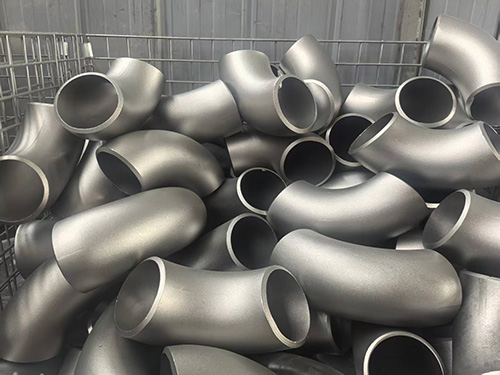
Stainless steel elbow is a high-performance curved pipe fitting used to change the flow direction of fluid in industrial piping systems. Available in 45°, 90°, 180° types with long radius and short radius options, it includes seamless and welded structures, mostly designed for butt-weld connection. Benefiting from excellent rust resistance and corrosion resistance, stainless steel elbow is an indispensable fitting for sanitary, marine and chemical piping systems where ordinary carbon steel cannot meet service requirements.
Stainless steel elbows are manufactured in accordance with international standards including ASME B36.19, ASME B36.10 and GB/T 12459. Multiple material grades are available to adapt to different media and working environments. A403 WP304 stainless steel elbow is the most widely used grade, suitable for weak corrosive fluid, purified water and general sanitary pipelines. A403 WP316L contains molybdenum element, delivering outstanding resistance to chloride corrosion, making it ideal for seawater treatment, brine and organic chemical medium transportation. Other optional grades cover WP321 for high-temperature anti-intergranular corrosion and duplex stainless steel elbows for severe corrosive working conditions. Seamless production is adopted for small and medium diameters, while large-caliber specifications can be produced by plate rolling and welding forming.
Hot pushing and cold bending are core forming processes for seamless stainless steel elbows. Integral stainless steel pipe blanks are processed via special molds to form smooth curved arcs. After forming, solution heat treatment is carried out to eliminate processing residual stress, restore the passive film structure and improve material toughness. Both ends are precisely machined into standard welding bevels for full penetration butt welding. All finished stainless steel elbows undergo strict quality inspection, including dimension check, wall thickness measurement, surface inspection and non-destructive testing to detect wrinkles, local thinning and microcracks on bending sections. Finally, pickling and passivation treatment is implemented to form a compact protective film on the surface and enhance anti-corrosion performance.
The core advantage of stainless steel elbow originates from its stable anti-corrosion property. A dense chromium oxide passive film automatically forms on the metal surface. When slight surface damage occurs, the film can self-repair to prevent oxidation and corrosion. It avoids rust pollution to conveyed media, which satisfies strict sanitary standards for food and pharmaceutical production. The smooth inner surface reduces medium adhesion, effectively lowering scaling and sediment accumulation. Long radius stainless steel elbows feature mild bending radian, small flow resistance and low abrasion, which are preferred for most process pipelines. Short radius models are selected when installation space is limited.
Engineers should pay attention to key limitations during selection and construction. Stainless steel is prone to crevice corrosion and pitting corrosion in high-chloride environments without proper sealing design. Besides, stainless steel has obvious thermal conductivity differences compared with carbon steel, requiring matched welding materials and standardized welding procedures. Improper high-temperature welding will destroy the passive film and cause local corrosion risk in the welding zone. It is not recommended to use short radius stainless steel elbows for pipelines transporting media containing solid particles to reduce erosion wear.
Stainless steel elbows are widely applied in numerous high-standard industrial fields. Typical scenarios include food processing production lines, biopharmaceutical workshops, purified water circulation systems, seawater desalination projects, environmental wastewater treatment, fine chemical pipelines and marine equipment piping. Stainless steel elbows become the primary choice for all projects with anti-rust, anti-corrosion and sanitary requirements.
In piping engineering design, medium composition, operating temperature and corrosion risk are key factors to select suitable stainless steel grades. Although stainless steel elbows have higher procurement costs than carbon steel fittings, they greatly extend service life and reduce later maintenance expenses. With complete specification series and mature forming technology, premium stainless steel elbows provide long-term reliable flow steering solutions. As a vital corrosion-resistant pipe fitting, stainless steel elbow guarantees clean, stable and leak-free operation of fluid transportation systems worldwide.