
-
E-mail:
hbjn1875@gmail.com -
Tel:
8617363170189
E-mail:
hbjn1875@gmail.comTel:
8617363170189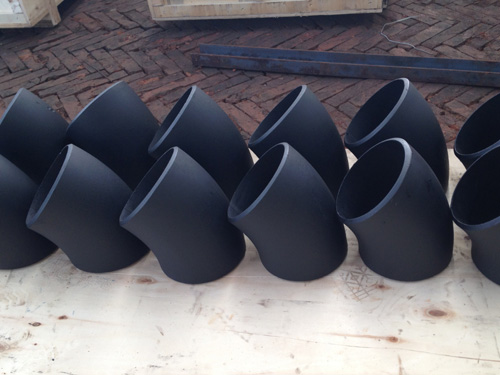
45 degree elbow is a commonly used curved pipe fitting applied to gently change the flow direction of medium in industrial piping systems. Compared with 90-degree and 180-degree elbows that realize sharp steering, the 45° elbow provides mild flow deflection, forming a smooth transition angle between straight pipe sections. This fitting is mainly connected by butt welding and available in seamless and welded structures. Thanks to lower fluid resistance, it is extensively adopted in complex pipe rack layout, drainage pipelines and process piping requiring slow flow direction adjustment.
45 degree elbows are manufactured in accordance with international standards including ASME B36.10, ASME B36.19 and GB/T 12459. A wide range of material grades can be customized for various working environments. Carbon steel 45 degree elbows marked A234 WPB have prominent cost advantages, suitable for pipelines transporting water, steam, fuel oil and compressed air. Stainless steel versions such as A403 WP304 and WP316L deliver reliable corrosion resistance, ideal for food, pharmaceutical, wastewater treatment and chemical pipelines with weakly corrosive media. Alloy steel grades including A234 WP11, WP22 and WP91 are specially produced to adapt to high-temperature and high-pressure service in thermal power plants, oil refineries and coal chemical facilities. Most specifications adopt long radius design; customized short radius 45° elbows can be supplied upon special space-limited requirements.
Hot pushing and cold forming are the mainstream molding processes for seamless 45 degree elbows. Raw pipe blanks are heated and extruded via professional molds to form uniform arc surfaces. Large-diameter 45° elbows can be fabricated through plate rolling and longitudinal welding. After forming, normalizing and tempering heat treatment is carried out to eliminate residual stress produced during bending deformation and enhance material plasticity and toughness. Both ends are precisely processed with standard welding bevels to achieve full penetration butt welding with matching straight pipes. All finished products pass strict quality inspection, including dimension verification, wall thickness measurement, surface visual inspection and ultrasonic non-destructive testing to detect defects such as local thinning, cracks and surface wrinkles on bending arcs.
The most outstanding characteristic of 45 degree elbow is low flow resistance. The gentle bending angle reduces fluid turbulence, effectively cutting pressure loss and medium erosion to the pipe inner wall. When designing complicated pipeline routes, multiple 45° elbows can be combined to realize flexible direction adjustment, avoiding sharp turns brought by 90° elbows. Such design prolongs the service life of pipelines, especially for medium containing fine solid particles. Meanwhile, the smooth arc structure reduces the risk of impurity deposition inside the pipeline, which brings obvious benefits for circulating and drainage systems.
Designers should clarify applicable restrictions during type selection. The 45° elbow occupies longer linear space than 90° elbow when changing the same horizontal offset. It is not suitable for compact equipment piping with extremely limited installation space. In such scenarios, 90-degree elbows become a more reasonable alternative. Besides, proper pipeline supports need to be arranged nearby to share axial thrust generated by fluid and prevent excessive stress concentration on welding joints.
45 degree elbows cover diversified engineering application fields. They are widely used in petrochemical process pipelines, power plant circulating water systems, municipal water supply and drainage networks, heating pipelines, environmental flue gas and wastewater piping. Stainless steel 45° elbows are favored in biochemical and seawater treatment projects, while carbon steel products occupy the main market of general industrial and municipal infrastructure piping.
In overall pipeline layout planning, 45 degree elbows are an indispensable optimized choice for low-resistance flow design. When flow stability needs priority, engineers prefer to adopt 45° elbows instead of sharp-angle elbows to reduce energy consumption of fluid transportation. With complete specification series and mature molding technology, qualified 45 degree elbows provide economical and stable flow steering solutions. As a basic directional pipe fitting, the 45 degree elbow guarantees low-loss, stable and secure operation of fluid transportation systems across global industries.