
-
E-mail:
hbjn1875@gmail.com -
Tel:
8617363170189
E-mail:
hbjn1875@gmail.comTel:
8617363170189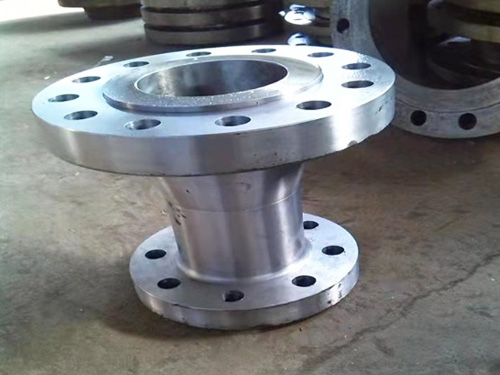
Reducing flange, also known as a reducer flange, is an integrated multifunctional connecting fitting that combines the functions of a standard flange and a pipe reducer. It can directly connect two pipelines with different nominal diameters while providing bolted flange joints. Instead of separately assembling a common flange matched with a pipe reducer, this integrated component simplifies pipeline layout and reduces the number of welding joints. Thanks to its compact structure, the reducing flange is widely adopted in limited installation spaces and branch pipelines requiring diameter transition, serving as an optimized solution for complex piping design.
Reducing flanges are manufactured in accordance with international specifications including ASME B16.5 and GB/T 9113. A wide range of material grades can be customized for various operating conditions. A105 carbon steel reducing flanges have prominent cost advantages, suitable for water, steam, compressed air and fuel transportation systems. Stainless steel reducing flanges in grades F304 and F316L feature reliable corrosion resistance, meeting the requirements of food, pharmaceutical and fine chemical pipelines transporting weakly corrosive media. Alloy steel variants such as A182 F11, F22 and F91 are developed for high-temperature and high-pressure working environments in thermal power plants and petrochemical facilities. Available pressure classes cover Class 150 to Class 1500, and raised face (RF) is the mainstream sealing surface configuration. RTJ sealing face can be supplied for critical high-pressure working conditions upon customer requests.
Hot forging is the dominant forming process for reducing flanges. Whole steel billets are heated and forged into integrated blanks combining flange plate and tapered reducing section. Subsequent precision machining includes processing sealing surfaces, drilling standard bolt holes and finishing pipe connection ends. Corresponding heat treatment such as normalizing and tempering is carried out to eliminate residual forging stress and refine internal metal grain structure. All finished products go through strict quality control, including dimensional tolerance inspection, hardness testing, visual surface examination and non-destructive testing, to detect internal defects such as cracks and material laminations.
The biggest competitive advantage of reducing flanges lies in integrated structural design. Traditional transition schemes need independent flanges and reducers connected by welding, which increases welding seams, potential leakage points and construction workload. The one-piece reducing flange minimizes joint quantity, lowers leakage risks and shortens on-site construction cycles. It effectively saves installation space, which is extremely valuable for compact equipment modules, container piping and crowded pipe racks. Engineers can streamline drawing design and reduce the quantity of spare parts during project procurement.
Nevertheless, certain limitations should be taken into consideration during type selection. Due to integrated forging molding, reducing flanges have fewer available size combinations compared with separate flanges and reducers. Custom sizes usually require longer production lead time. Besides, stress distribution on the transition taper needs strict verification. They are not recommended for pipelines bearing severe vibration and frequent drastic temperature changes. For ultra-high pressure critical pipelines, separated weld neck flange plus concentric reducer remains a more reliable alternative.
Reducing flanges are applied in diversified industrial scenarios. They are commonly used for equipment inlet and outlet connections, pipeline branch transitions, auxiliary instrument piping, municipal heating networks and fire protection systems. Stainless steel reducing flanges are widely used in purified water treatment and biochemical production lines. Carbon steel reducing flanges occupy a large share in general industrial equipment and infrastructure projects.
In pipeline engineering design, reducing flanges serve as an efficient alternative for diameter transition connection. When installation space is restricted and fewer welding joints are required, reducing flanges can greatly optimize the overall piping layout. With standardized forging techniques and abundant conventional specifications, high-quality reducing flanges provide compact and reliable transition connection solutions. As a special customized flange product, reducing flange facilitates neat arrangement of pipeline networks and guarantees safe and stable operation of fluid conveying systems worldwide.