
-
E-mail:
hbjn1875@gmail.com -
Tel:
8617363170189
E-mail:
hbjn1875@gmail.comTel:
8617363170189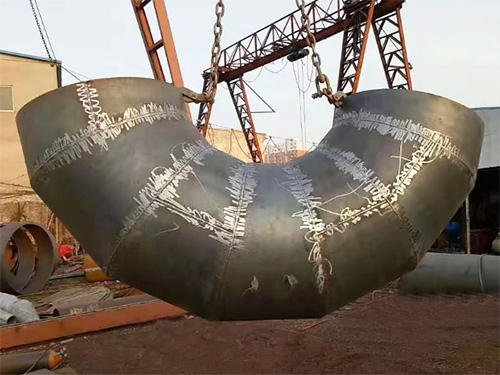
Miter bend,also referred to as segmented miter elbow,is a pipe bend assembled by cutting multiple straight pipe sections at specific angles and welding the cut ends together to form a curved pipeline transition.Unlike integral formed seamless induction bends,it is a fabricated pipe fitting rather than a one-piece molded component.Thanks to flexible production and low manufacturing cost,miter bends are commonly used in low and medium-pressure ventilation,exhaust and general fluid piping systems where strict pressure requirements are not demanded.
The production process of miter bend mainly includes pipe cutting,edge preparation,assembly and welding.Manufacturers cut straight pipes into several pipe segments with inclined cutting surfaces.The typical single-joint miter bend consists of two pipe sections,while multi-joint miter bends adopt three,five or more segments to create a smoother curve.More segments can reduce sharp turning angles and ease airflow resistance.After splicing all segments to form the target bending angle,full penetration welding is carried out at every joint.Post-weld treatment such as grinding and anti-corrosion coating will be conducted to enhance surface quality.Carbon steel,galvanized steel and stainless steel are the most widely used raw materials for miter bends.
Miter bends have obvious pros and cons compared with seamless induction bends.The biggest advantage lies in high flexibility.Special bending radii and large-diameter specifications that are hard to achieve by hot bending can be customized easily.Production costs are lower,and the delivery cycle is shorter,especially for large-size ventilation ducts.Nevertheless,inherent limitations cannot be ignored.Multiple welding seams exist on the miter bend.Weld joints become potential weak points vulnerable to corrosion,fatigue cracks and leakage under sustained high pressure or vibration.In addition,the segmented inner surface creates abrupt changes,generating greater turbulence and higher pressure loss during medium transportation.For this reason,miter bends are not suitable for high-pressure,high-temperature flammable and explosive medium transmission pipelines.
Miter bends are widely applied in industrial ventilation systems,dust removal pipelines,factory exhaust ducts,municipal smoke pipelines and low-pressure water delivery projects.Multi-segment miter bends are preferred when installation space is limited and large-radius integrated bends cannot be arranged.Relevant production follows duct engineering standards to guarantee welding quality and structural stability.Regular inspection on weld seams is necessary after long-term operation to prevent medium leakage.
In summary,the miter bend is an economical and customizable pipe transition fitting oriented toward low-pressure working conditions.Although its performance cannot match integrally formed seamless bends for heavy-duty industrial pipelines,it provides a cost-effective solution for ventilation and low-pressure piping engineering.Proper selection based on working pressure,medium characteristics and flow requirements helps achieve a balanced outcome between construction budget and pipeline safety.