
-
E-mail:
hbjn1875@gmail.com -
Tel:
8617363170189
E-mail:
hbjn1875@gmail.comTel:
8617363170189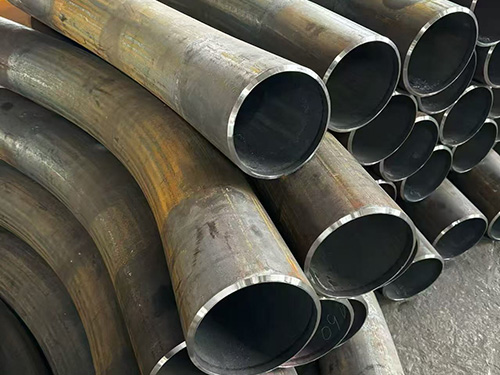
Induction pipe bend, also known as hot induction pipe bend, is a high-precision and high-reliability pipe fitting widely adopted in modern industrial piping systems. It is manufactured through advanced electromagnetic induction hot bending technology, which differs greatly from traditional cold bending and conventional hot bending processes. As a core component for changing pipeline direction, it has become an indispensable part of oil and gas transmission, petrochemical, power generation, municipal engineering and heavy industrial fields due to its superior structural performance and stable mechanical properties.
The manufacturing principle of induction pipe bend is based on electromagnetic induction heating and precise plastic deformation control. During production, a high-frequency induction coil generates a localized alternating electromagnetic field, which rapidly heats a narrow annular zone of the straight pipe to a plastic forming temperature ranging from 850°C to 1100°C, adjusted according to different pipe materials. Unlike integral heating methods, this process only heats the target bending area while keeping other parts of the pipe at normal temperature. With the synchronous action of hydraulic propulsion and rotary positioning equipment, the heated pipe section is slowly and evenly bent to the preset radius and angle. After bending, targeted cooling and heat treatment are conducted to eliminate internal stress, stabilize the metal microstructure, and ensure the overall performance of the pipe bend.
One of the most prominent advantages of induction pipe bend is its excellent structural uniformity. The controlled local heating and continuous bending process effectively avoid common defects of traditional bending, such as uneven wall thickness, cross-section ovality, surface wrinkling and internal cracking. It maintains consistent wall thickness throughout the bending section, with minimal dimensional deviation, which greatly reduces fluid turbulence and pressure loss during pipeline operation. Meanwhile, the integrated forming process without welding joints enhances the structural integrity of the bend, effectively resisting high pressure, high temperature and corrosive media, and significantly improving the safety and service life of the pipeline system.
Induction pipe bends follow strict international industry standards including ASME B16.49 and ISO 15590-1, and support customized specifications to meet diverse engineering demands. Common bending radii include 3D, 5D and 7D (D refers to the nominal pipe diameter), with optional bending angles from 0° to 180°. It is compatible with various metal materials such as carbon steel, alloy steel and stainless steel, covering mainstream pipeline grades like API 5L series and A234 WPB. These flexible specifications enable it to adapt to complex working conditions ranging from conventional water and gas transmission to high-pressure, high-temperature industrial fluid delivery.
In practical applications, induction pipe bends irreplaceably replace ordinary elbow fittings in heavy-duty and long-distance pipeline projects. Ordinary short-radius elbows are prone to severe fluid erosion and pressure drop, while long-radius induction bends ensure smooth fluid flow, reduce pipeline resistance and lower long-term operation and maintenance costs. In power plants, chemical plants and cross-regional oil and gas transmission pipelines, they effectively withstand long-term cyclic load and harsh environmental erosion, guaranteeing the stable and continuous operation of the entire piping system.
In conclusion, induction pipe bend represents a mature and advanced pipe bending technology. Combining precise heating control, stable plastic forming and reliable mechanical performance, it solves the performance bottlenecks of traditional pipe fittings. With high safety, durability and applicability, it has become a key basic component for modern industrial pipeline engineering, providing solid technical support for the efficient and safe operation of various industrial fluid transmission systems.