
-
E-mail:
hbjn1875@gmail.com -
Tel:
8617363170189
E-mail:
hbjn1875@gmail.comTel:
8617363170189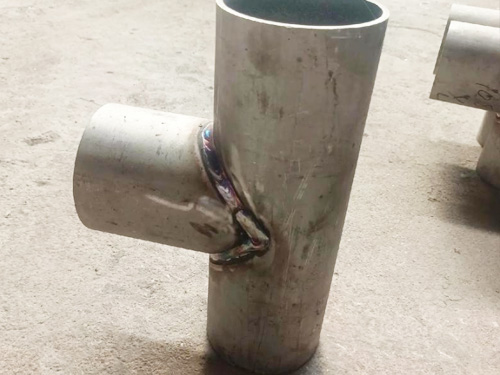
A butt weld tee is an essential butt-welded pipe fitting used to split or combine fluid flow in industrial piping networks. It connects with pipes via butt welding, forming permanent, leak-proof joints, and is extensively utilized for medium and high-pressure pipeline projects across global industries. Different from threaded or socket-weld tees suitable for small-bore low-pressure pipelines, butt weld tees are designed to match the wall thickness of seamless and welded steel pipes, achieving consistent structural strength after welding construction.
Manufacturers produce butt weld tees in accordance with internationally recognized standards, primarily ASME B16.9 and GB/T 12459. Common manufacturing techniques include hot forming, cold forming and forging. Raw materials cover carbon steel, stainless steel, alloy steel and duplex stainless steel, covering grades such as A234 WPB, 304, 316L, A403 WP321 and WP91. Two mainstream types are available: equal butt weld tees and reducing butt weld tees. Equal tees have identical diameters for the run and branch outlets for uniform flow distribution. Reducing tees feature a smaller branch connection, which realizes flow diversion and pipe size transition simultaneously to satisfy complex pipeline layout demands.
Every qualified butt weld tee undergoes rigorous quality control procedures. Raw material chemical composition and mechanical property inspections are carried out before production. After forming, heat treatment is implemented to eliminate internal stress and optimize the internal metal texture of the fitting. Finished products are processed with precise end preparation to form standardized welding bevels, ensuring perfect alignment during on-site butt welding. Non-destructive testing including ultrasonic testing and magnetic particle inspection is adopted to detect hidden defects like internal cracks, porosity and inclusions, guaranteeing reliability under harsh working conditions.
The core strengths of butt weld tees lie in outstanding connection integrity and pressure-bearing capacity. After full penetration butt welding, the joint reaches equivalent strength to the base pipe. The smooth inner surface reduces fluid friction loss, lowering energy consumption for medium transportation. The fitting can withstand high temperature, high pressure, vibration and chemical corrosion, adapting to long-term continuous operation. Moreover, butt welded connections allow insulation wrapping directly on the exterior surface of pipelines and fittings without structural obstruction, which is highly favorable for thermal power, oil and gas transmission systems that require thermal insulation.
Butt weld tees serve a wide range of demanding engineering scenarios. They are widely adopted in petrochemical plants, natural gas transmission pipelines, thermal power stations, chemical fertilizer factories, water treatment systems and marine engineering. Stainless steel butt weld tees are popular in food manufacturing, pharmaceutical and beverage industries where medium purity and anti-contamination requirements are strict. Alloy steel variants work for high-temperature steam pipelines and hydrogen transmission projects.
In industrial piping engineering selection, butt weld tees remain the dominant choice for large-diameter, high-pressure permanent piping systems. When properly matched with welding processes and inspection standards, they effectively reduce risks of medium leakage, pipeline failure and unplanned shutdown. As industrial safety requirements keep rising, standardized butt weld tees continue to be fundamental components ensuring secure and stable operation of global fluid transportation infrastructure.