
-
E-mail:
hbjn1875@gmail.com -
Tel:
8617363170189
E-mail:
hbjn1875@gmail.comTel:
8617363170189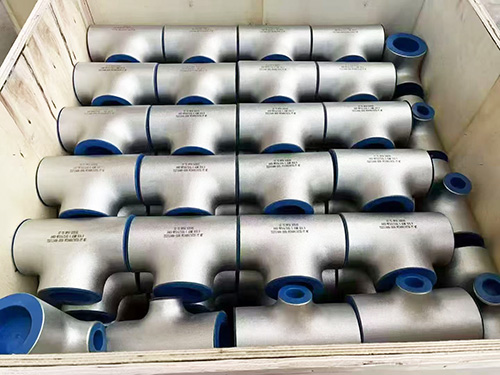
Pipe tee is one of the most widely used branch fittings in industrial piping systems.Named after its T-shaped outline,it enables fluid diversion,convergence or flow distribution by connecting three pipe sections at one joint.As a vital component for pipeline network layout,the pipe tee can split a single main pipeline into two branch pipelines or combine two separate pipelines into one.According to structural forms,it is generally divided into equal tee and reducing tee.An equal tee features identical nominal diameters for all three ports,while a reducing tee comes with smaller branch outlet to match different pipe sizes.It can be manufactured as seamless forged tee or welded tee to fit various pressure grades and working media.
The production methods of pipe tees mainly include hydraulic bulging,hot extrusion,forging and welding forming.Seamless tees are normally produced by hot extrusion or cold hydraulic bulging.Under controlled pressure and temperature,the blank pipe undergoes plastic deformation to extrude the branch opening integrally without cutting and splicing.Welded tees are fabricated by cutting openings on the main pipe and welding branch pipes onto the joint area.Raw materials cover carbon steel,alloy steel and stainless steel to adapt to diverse operating environments.After forming,finished tees are processed with bevel preparation,surface polishing and anti-rust treatment.Strict non-destructive testing is conducted to detect hidden defects such as internal cracks and thinning,ensuring compliance with international standards including ASME B16.9 and GB standards.
Pipe tees possess outstanding structural advantages for fluid distribution.The integrally formed seamless tee has no weak welding joints inside,presenting excellent pressure resistance and sealing performance.Smooth inner transition reduces fluid turbulence and pressure loss during medium diversion.Compared with on-site branch opening,factory-produced tees have uniform wall thickness and stable mechanical properties,avoiding local stress concentration caused by random cutting on straight pipes.However,the tee joint naturally creates flow impact at the intersection,which may cause erosion after long-term operation of high-speed flowing media.For harsh working conditions,optimized internal curved transition design is adopted to mitigate abrasion.
Pipe tees are extensively applied in petroleum and gas transmission,petrochemical plants,thermal power stations,urban heating networks,water supply and drainage systems as well as marine piping projects.Equal tees are used when the main pipe and branch pipe share the same diameter,while reducing tees are adopted for pipelines requiring flow adjustment.Seamless forged tees are preferred for high-temperature,high-pressure pipelines carrying flammable and corrosive media,whereas welded tees serve low and medium-pressure ventilation and circulating water systems for cost control.
In conclusion,the pipe tee is an indispensable fitting for building complex pipeline networks.It provides reliable flow splitting and merging functions for fluid transmission systems.With multiple specifications and forming processes available,pipe tees can meet differentiated engineering demands.Reasonable type selection according to pressure,medium and flow parameters ensures safe,stable and long-term operation of the whole piping system.